Khoury News
Brianna Dym’s “20-year project”: Examining barriers and belonging in remote communities
The Portland-based professor has long noticed the isolation of remote communities, and she believes that tailored technology can serve as connective tissue for education, socializing, and everyday tasks.
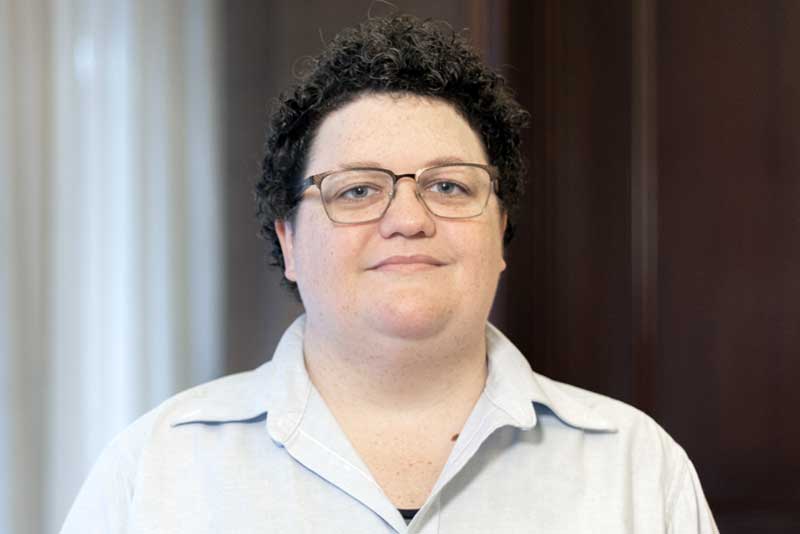
Brianna Dym, an assistant teaching professor with Khoury College at the Roux Institute in Portland, Maine, has found solace in remote populations.
Since beginning her undergraduate education in 2008 at the University of Alaska, she has immersed herself in geographically remote communities to study how isolation, limited resources, and power imbalances impact people’s relationships with technology.
“My research goal has moved to … how do I help people build and use technologies in such a way that they can live autonomously without being dependent upon major tech companies that they can’t push back against or argue with,” Dym said. “Especially when it comes to making sure that their privacy and safety are respected.”
As a qualitative researcher, Dym relies on autoethnography, where she studies her own experiences alongside the experiences of the community. She then combs through interview data, observations, and survey responses to identify common themes, with her latest iteration focusing on members of the LGBTQ+ community.
“It’s a very powerful perspective to do research from, but it’s not without risks, in that your personal wants and needs bias you,” she said. “I think the most important part of being a good researcher is recognizing your bias and then trying to understand what your bias can offer.”
When she was 17, Dym moved to Anchorage, Alaska, where infrastructural deficiencies among rural populations were easy to spot. With many islands accessible only by boat or plane, and with limited road connections on the mainland, food and other goods were far more accessible to those who lived along the road system.
“Rural communities will always have less of a voice than their urban counterparts,” Dym said.
Those geographic constraints were presented again when Dym moved to Maine in 2022. In both places, weak technological systems and physical isolation compound everyday challenges. According to Dym, it can take hours to download files, map and routing data for navigation is difficult to access, and Google applications and YouTube videos are often inaccessible. She wondered how learning at all levels of education could function under these conditions.
“Because remote populations couldn’t access good bandwidth, they couldn’t use the educational tools that people in cities did, so you couldn’t design curricula the same way,” Dym said. “I got very interested in those kinds of problems as an educator.”
Beyond education, the lack of technological access inhibited people’s ability to foster community.
“There are so many really beautiful, cool things people can do when they connect with each other on the internet,” Dym said. “I was running into people living in rural spaces who were having trouble finding those connections.”
She soon realized that many people had no choice but to rely on technology to forge these connections. As information infrastructures have changed, platforms such as Facebook groups and Instagram pages have provided important ways to connect.
“What I found is that people might want to divest themselves from these technologies, but they can’t; we don’t have alternative infrastructures now,” Dym said. “My perspective changed from thinking about advocacy for regulatory changes to ‘How do I put power and control back in other people’s hands?’”
Ultimately, Dym argues that we have more control than we think. Inspired by author Ursula K. Le Guin, she is reminded that technology is something people actively shape and do not have to passively accept.
“I don’t think we are powerless. I think there are ways to push back,” Dym said. “Information technology is literally defined by us. We can define how it operates.”
As she continues her study by talking to people about the tension between privacy versus connection, she has also published curricula and research online through ACM. What began as academic research has evolved into a long-term mission to help communities use tools that allow them to live independently without relying on large technology companies.
“I call it my 20-year project,” Dym said. “The problem I’m interested in solving is the lack of autonomy.”
The Khoury Network: Be in the know
Subscribe now to our monthly newsletter for the latest stories and achievements of our students and faculty