Khoury News
Applying for a grant in Massachusetts? This new AI tool makes it much easier.
After partnering with the Massachusetts government and consulting grant writers across the state, Northeastern's Burnes Center debuted GrantWell. Six months later, the tool has proved itself to be a time-saving triumph.
In 2025, Massachusetts communities were eligible for about $17.5 billion in federal grants. They got less than a third of that money.
The biggest culprit is a complex and burdensome grant process. To toss their hat into the ring, organizations need to sift through hundreds of pages of Notice of Funding Opportunity (NOFO) documents to understand their eligibility, then write lengthy application materials. When the organization is a small, understaffed team providing housing and shelter services, those funds might as well be on the moon.
Meeting that team was one of the most impactful moments of Jai Surya Kode’s AI for Impact co-op at Northeastern’s Burnes Center for Social Change.
“Their goal is to make sure everybody has shelter; most of their work is just that. They don’t have time to think about grant writing, tracking new funding opportunities, and managing the grant process,” he said. “But with greater access to grant funding, they could expand services and support more people experiencing homelessness.”
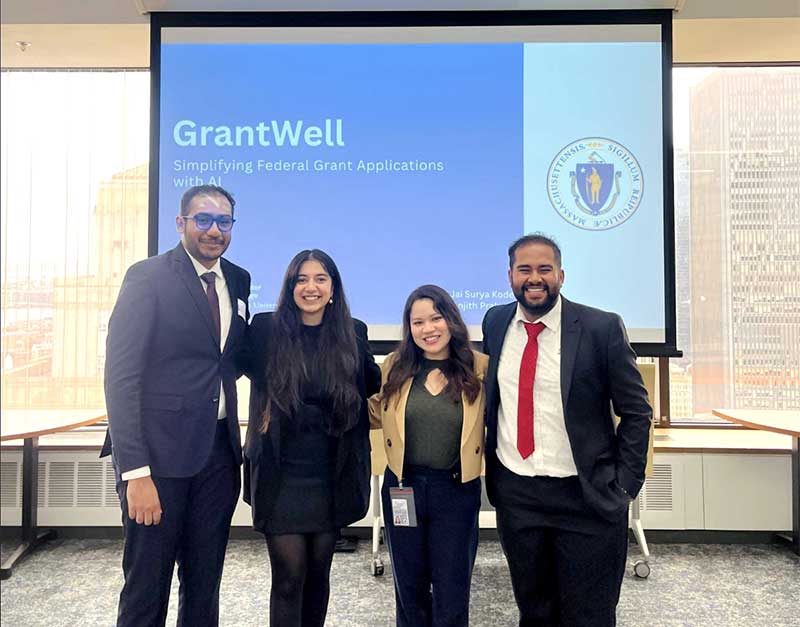
Kode kept that meeting in mind as he and his fellow co-op, Anjith Prakash Chathan Kandy, worked on GrantWell, AI for Impact’s publicly available, AI-powered platform that magnifies funding under-resourced communities can access by simplifying the grant process.
“We’ve heard from communities loud and clear that onerous paperwork is a barrier to getting good projects done,” Massachusetts Governor Maura Healey said when the program launched in March. “Now with GrantWell, we’re making it even easier for communities to take advantage of those opportunities and apply for the funds they need.”
While it may appear that GrantWell’s magic is in its clever technology, Kode and Chathan Kandy know that the real problem-solving happened in the deliberate co-design process with Massachusetts’ municipal grant writers.
“What we are developing is for the community,” Chathan Kandy said. “We need to make sure that we have served the community.”
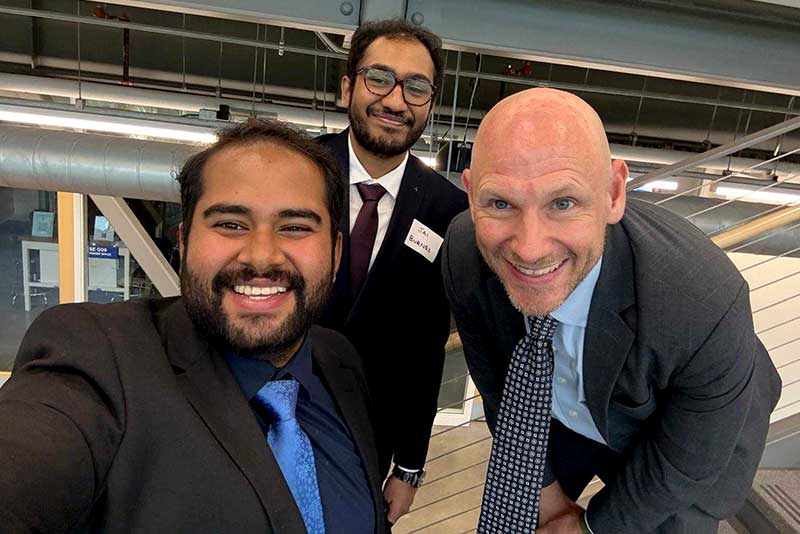
GrantWell began when the Massachusetts Federal Funds Infrastructure Office (FFIO) approached the Burnes Center about designing an AI tool to improve access to federal grant funds. So, in the spring of 2025, the Burnes Center hired two co-ops — Kode and Chathan Kandy, then second-year master’s students studying AI at Khoury College. Initially, Kode and Chathan Kandy thought they’d be building a chatbot, but as they crossed Massachusetts and met grant writers and agencies from New Bedford to Essex, their understanding of the grant writing community’s needs evolved.
“We realized grant writing is not exactly the issue; finding grants in the first place is,” Chathan Kandy said. “Many grant writers we met had decades of experience. They did not need AI to teach them grant writing. But in under-resourced or understaffed municipalities, there might be one person doing 10 jobs. It would be harder to find a grant and make sure they’re eligible.”
As the co-ops collected thoughtful feedback in their conversations with the grant writing community, they also discovered understandable concerns.
“What really hit us was skepticism from grant writers about whether AI could replace parts of their work,’” Kode said. “Their main concern was that GrantWell would write a whole grant and apply to it directly … they do that for a livelihood. We had to make sure that wasn’t the case.”
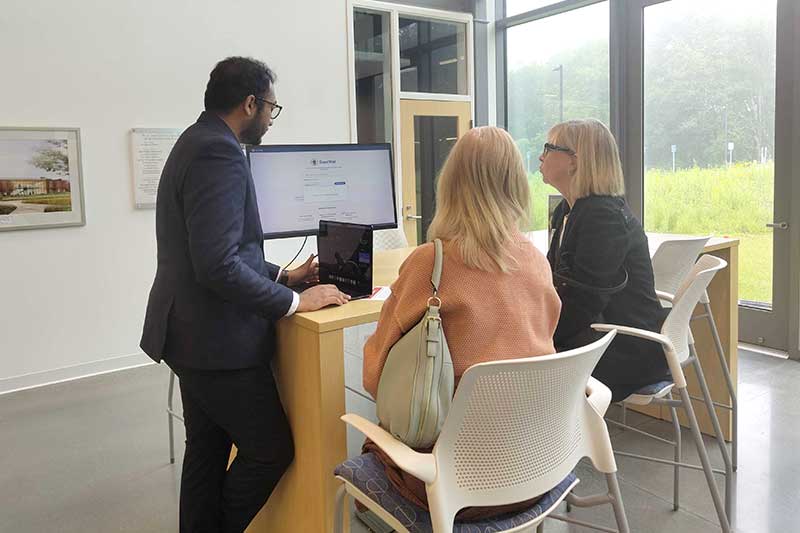
So instead, Kode and Chathan Kandy focused on GrantWell’s capacities to search for grants, investigate their requirements, and get an applicant quickly from a project idea to an application draft. To understand GrantWell’s support features, imagine you work for a municipality pursuing funding for a bike lane project.
| GrantWell | Traditional grant application |
|---|---|
| Create an account on GrantWell. Complete two-factor authentication. | Create an account on grants.gov. Register through SAM.gov; allow up to 10 business days for processing. Register an org profile on grants.gov. For each application, create a workspace on grants.gov and assign roles and permissions to members of your team. |
| Use GrantWell’s search feature to browse ~1,500 available grants. The search “bike lane” returns four relevant grants matching the municipality’s needs. | Use the grants.gov search feature to browse ~1,900 available grants. The search “bike lane” returns no results, so use broader terms like “transportation” (67 results) and “safety” (137). |
| GrantWell retrieves and analyzes NOFO docs and presents eligibility criteria, required docs, deadlines, and a list of required narrative sections. Repeat for all four “bike lane” results. | Manually review 40–100 pages of NOFO docs for that same info. Repeat for all 204 “transportation” and “safety” search results. |
| Select your grant. | Select your grant. |
| Select GrantWell’s AI assistant. Provide context about your project in plain language; GrantWell writes a first draft. | Use the Forms tab to view and complete required forms. Draft all narrative content from scratch. |
From that point, the process is identical. Human grant writers edit and improve narrative sections; create supporting documents like budgets; and format, finalize, submit, and monitor applications.
“What GrantWell produces is not a final draft, just a strong starting point to build upon,” Chathan Kandy said, stressing how seriously they’d taken the community’s fears about AI eliminating jobs. “These are grants worth millions of dollars; you always have a human in the loop.”
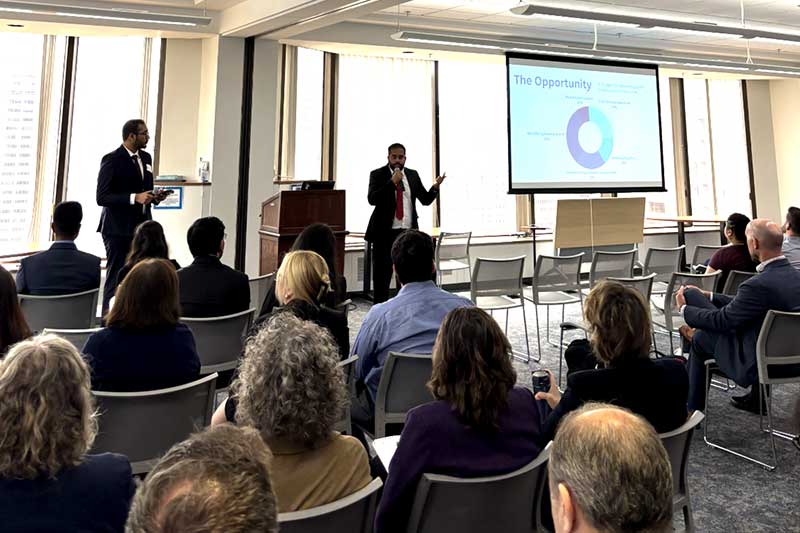
The reception to GrantWell has been strong and positive. Since its release in March, 350 users have registered across 200 Massachusetts communities, and over half have already used the platform more than once. Governments in California, Colorado, and Rhode Island are working with the Burnes Center to create versions specific to their states, and a general version is freely available to anyone online. Kode even received thank-you emails from people across Massachusetts who’d shared feedback and experiences about the grant process.
“It was only after we finished the platform and saw people use it that I fully understood its impact and realized that this level of community involvement is not always part of how technology is developed,” Kode said. “That experience set a high standard for the kind of work I want to do.”
That buy-in is why participatory design is core at the Burnes Center. Co-ops and fellows come in with strong technical skills, so the AI for Impact program’s weekly coaching sessions focus on participatory design skills like qualitative research, eliciting useful feedback, and interpersonal communication.
“The expertise that ordinary people have about their own lives is extraordinary,” said Beth Noveck, director of the Burnes Center and affiliate faculty at Khoury College. “You have to listen to them and learning how to do that can be difficult for students who are taught how to talk. Often in higher education we emphasize having them present, and that’s good too, but how to listen — and humility in that process — is a learned skill.”
Seeing his students’ growing ability to negotiate human-centered design processes is the best part of the job for David Fields, director of AI for Impact.
“We’ll help them with communication, setting up meetings, how to write a professional email and send after-meeting action items, but by the end of the term, we’re a fly on the wall,” Fields said. “Watching [Chathan Kandy and Kode] flourish with agency partners is the proof in the pudding. They developed their communication skills, their ability to pitch quickly, and frankly, they’re incredible technologists.”
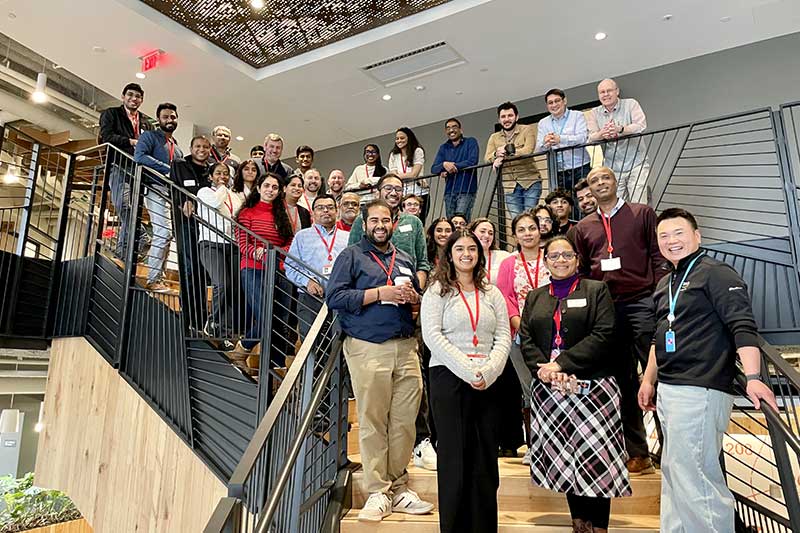
The team further credited recent Khoury graduates Shreya Thalvayapati (BS in Data Science and Economics), Serena Green (BS in Computer Science and Cognitive Psychology) and Deepikasai Mettu (MS in Data Analytics Engineering) for their valuable technical work on GrantWell. They also appreciated Burnes Center Senior Fellow Virginia Hamilton for her important contributions to the project’s graphic design, and City of Boston CIO Santiago “Santi” Garces, who advised the cohort.
After their co-ops ended, Chathan Kandy and Kode stayed on as part-time fellows at the Burnes Center to continue work on GrantWell, and after graduating in December of 2025, Chathan Kandy joined the Burnes Center full-time as an AI engineer. Both encourage students interested in public-sector tech to enroll in the new AI for Impact course. The course — co-taught by Noveck, Fields, Khoury lecturer Anirudh Dinesh, and College of Professional Studies professor Rob Asaro-Angelo — will guide students in taking a human-centered design approach to real-world problems. It will also serve as a pipeline for the increasingly popular AI for Impact co-op.
For Chathan Kandy, the most fulfilling part of the whole process has been seeing their work put to good use by people he met during his co-op. He smiled as he recalled one grant writer who told him that GrantWell had turned two or three days’ work into 10 or 15 minutes.
“The AI for Impact program is somewhere we can have real-world impact,” he said. “These features are there for everyone to use. Hopefully this makes life easier; they can put their time and expertise in better places.”
The Khoury Network: Be in the know
Subscribe now to our monthly newsletter for the latest stories and achievements of our students and faculty