Khoury News
Khoury connections: Vancouver students develop a mentorship website for alumni network
"The project has strong potential to grow into a go-to hub for the community," says lab advisor Neda Changizi. "The AI-driven matching system could become increasingly powerful as the user base scales."
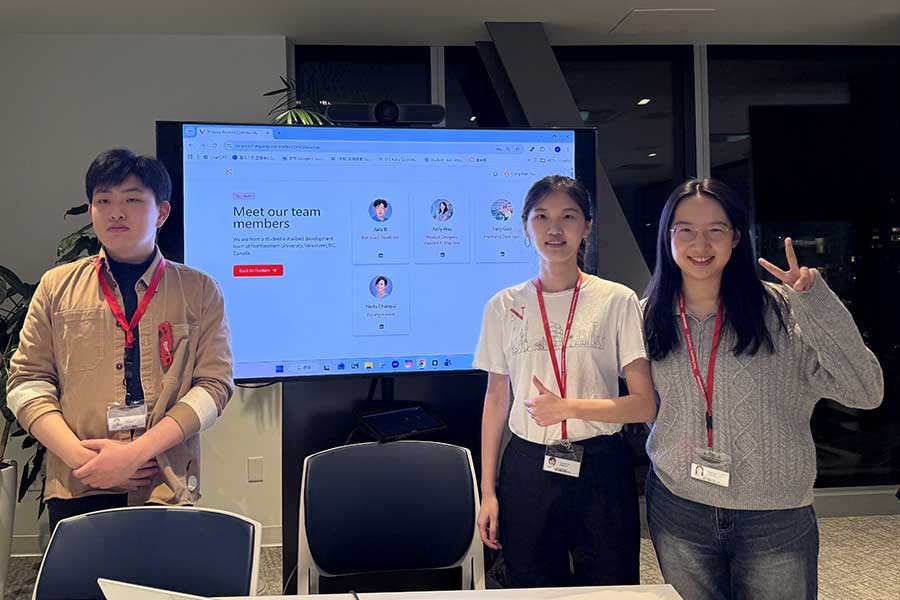
Khoury students looking to connect with alumni will no longer need to rely on sending cold emails or going through third parties to network, thanks to a new website developed to foster mentorship and connection.
During the summer of 2025, Kelly Hsu, a second-year, Vancouver-based computer science master’s student in the Align program, came up with the idea of creating a website to connect current students with alumni working in the students’ desired career field.
In the same year, Hsu collaborated with fellow second-year Align CS student Lucy Guo and a recent Align graduate, Jialu Bi, on a project for Project Forge Lab to start building the networking website outside of the classroom.
“The idea was inspired by another student project — a career pathways website that helped students choose courses based on their career interests,” said Neda Changizi, a clinical instructor and Project Forge Lab’s advisor. “That project sparked a broader question: Once students know where they want to go, how do they find the right people and opportunities to get there?”
Within the Northeastern community, some mentorship platforms require lengthy questionnaires and complicated email set-ups that prevent users from easily and actively customizing the tool to meet their needs. So, the trio built off the existing ideas, then made some improvements.
The result, which they call Khoury Alumni Community, was built to bring together Khoury scholars and professionals, “addressing the disconnect that often exists between alumni and current students — the absence of a structured, community-driven space to seek collaborators, share job referrals, or tap into the broader NU network,” Changizi said.
The website is currently offline for maintenance. But when live, its homepage, titled “Huskies,” will display name cards of Khoury students and alumni, along with their company, job title, technology field, mentorship status, and country, among other information. These categories will also be customizable in the search bar, allowing users to search more precisely.
Like other networking platforms, Khoury Alumni Community is compact — anyone visiting a profile can see not only basic information, but also a resume and activities.
Guo oversees the front-end development, the user interface, and the user experience elements of the website, including layout and interactivity. Bi designed the database of users’ information and built the functions that interact with the database; he is also in charge of developing a collection of users’ information, including names, years in college, industry, and employer. And for functions like matching similarities between users, the team relies on a back-end service called Firebase.
“Basically, it provides all of the functions that we need to interact with the database, which saves us so much time compared to building everything from scratch,” Bi explained.
Working with a dense network, Hsu then integrated OpenAI API into the website to facilitate matching of mentors and mentees.
“The most challenging decision was to design the algorithm to match the mentors and mentees,” Hsu said. “At first, we didn’t think of using a large language model, but we figured out that design from scratch is kind of difficult, so we started using the large language model to send information and instructions to get the outputs.”
The team will continue to run the website and is looking for more users to join, hoping it will become a widely used platform within Khoury College as well as the wider Northeastern community. Hsu, Guo, and Bi hope to add more features like a recruiting page and geographical map for users to visualize their network, as well as enhanced website security.
“The project has strong potential to grow into a go-to hub for the NU community. The AI-driven matching system could become increasingly powerful as the user base scales,” Changizi said. “With further development, it could expand beyond mentorship to support project collaboration, startup incubation, job referrals, and recruitment pipelines — making it a meaningful long-term asset for the university.”
The Khoury Network: Be in the know
Subscribe now to our monthly newsletter for the latest stories and achievements of our students and faculty