Khoury News
Meet Walter Hürsch, the computer scientist turning the Fibonacci sequence into art
After earning his PhD from Northeastern, Walter Hürsch spent more than 20 years in the tech industry. Now he's applying his scientific foundations to produce striking, satisfying, harmonious art.
For Khoury alumnus Walter Hürsch, the most everyday objects, even a golden semicircle hanging from the ear of a woman nearby, can serve as an inspiration.
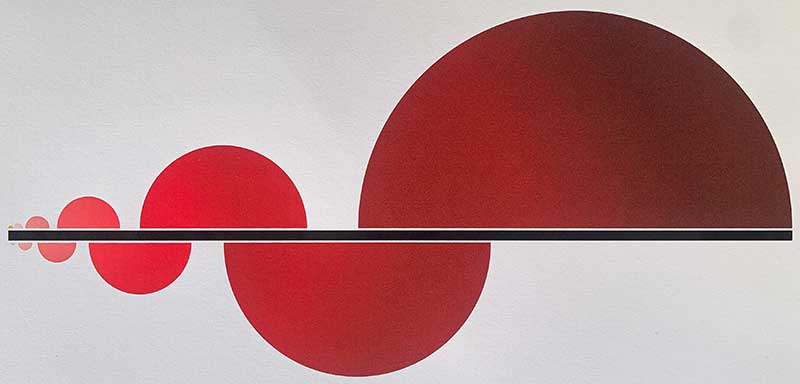
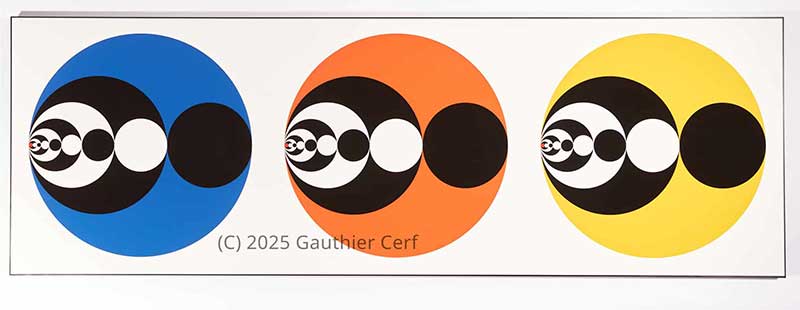
“I started to make a Fibonacci painting based on the semicircles,” Hürsch said. He added more semicircles red and black, arcing out in ever-larger curves along the precise mathematical ratio that defines his work. The design — which Hürsch was still polishing at the time of interview — aims to deliver a sense of harmony, scale, and progression, but “the gold one is where it all begins. That’s the seed where the Fibonacci numbers start, then they grow exponentially to infinity.”
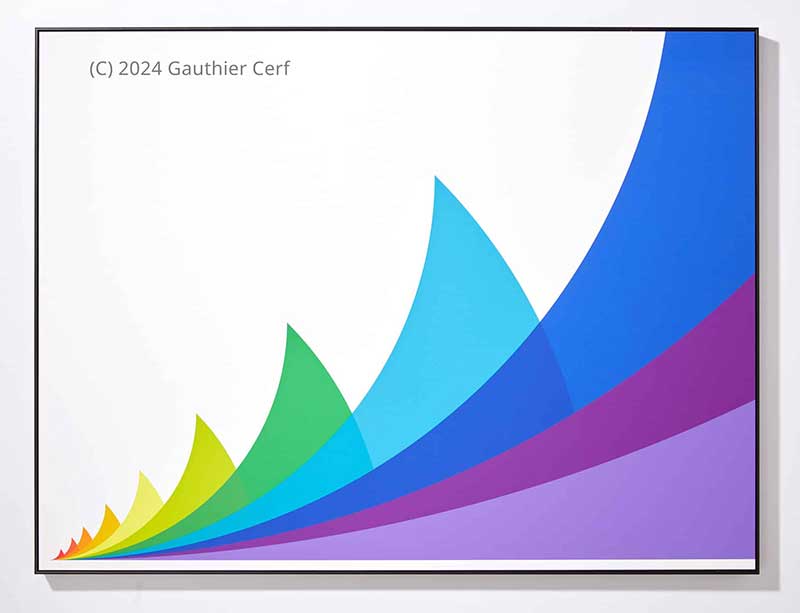
After getting his PhD in computer science in 1995 from Northeastern’s College of Computer Science (now Khoury College), Hürsch spent more than two decades implementing and managing technology services and leading tech startups. Then, in 2021, he launched a second career as an artist, exploring the expansive world of the Fibonacci sequence under the name Gauthier Cerf — a French translation of Hürsch’s name — and using bold abstract compositions to make known mathematical truths into felt aesthetic realities.
Hürsch’s transition into art didn’t come until he was 57. He had finished a six-year term as the CEO of the health care company BlueCare, and a number of other startups were offering board seats, C-suite positions, and venture capital investment proposals. Instead, Hürsch took a month off to hike through Switzerland and clear his head.
“That was the point where I thought, ‘What do I do next?’” Hürsch said. “The tech offers were fascinating, but somehow it was more of the same. I’ve seen technology and I love it, but there was another thing in me that I wanted to do.”
But even as he was ready to explore his artistic side, Hürsch carried his love for math and science, taking an artistic approach to mathematical truths in the form of Fibonacci art.
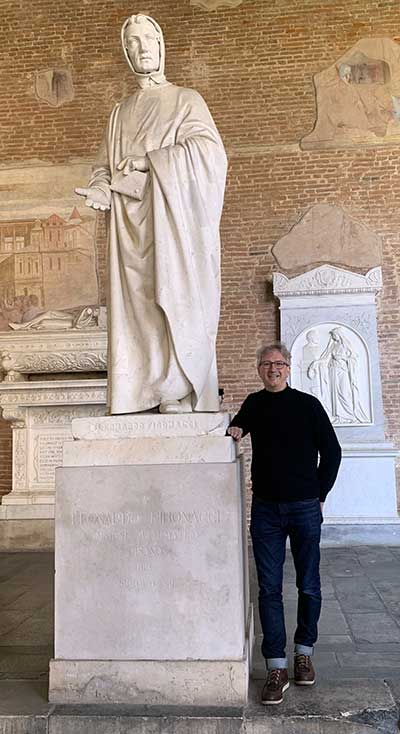
The Fibonacci number sequence — named for 12th-century mathematician Leonardo Bonacci — is reached by adding together the two previous numbers in the sequence: 1, 1, 2, 3, 5, 8, 13, 21, 34, 55, 89, and so on. Fibonacci art is artwork that uses or represents that sequence — in Hürsch’s case, by using bold colors and clear, balanced geometric composition.
“Fibonacci numbers are closely related to the equally famous golden ratio; this makes them harmonious numbers. Miraculously, they appear everywhere in nature,” Hürsch said. “This bridge from mathematics to nature appealed to me a lot.”
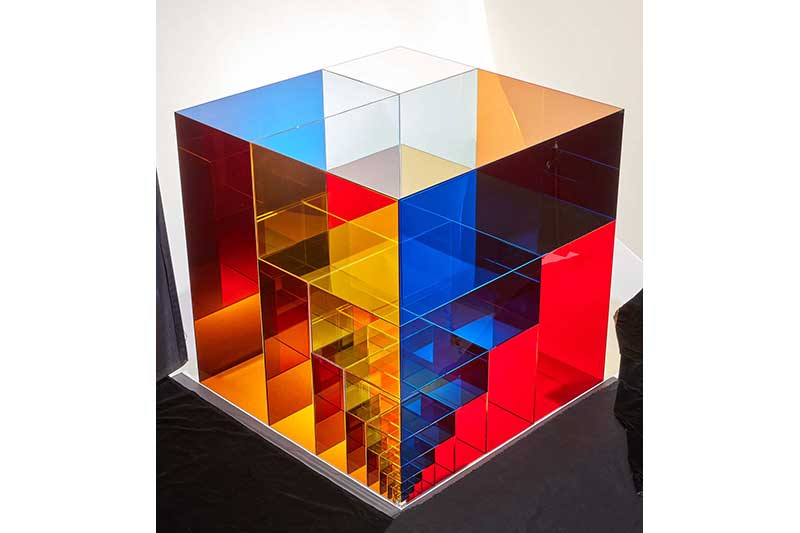
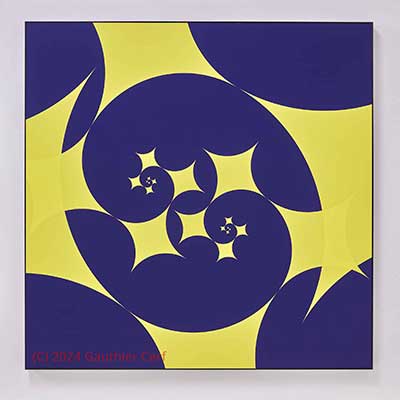
Hürsch began with two-dimensional works, using circles, rectangles, and sweeping curves to visualize various properties of Fibonacci numbers. An old-school mathematician at heart, he starts his process with sketches and equations on paper then moves to computer models and digital art. After a slew of iterations, the final work is printed, framed, and hung.
In 2023, Hürsch began adding sculptures to his portfolio. Built from precision-cut acrylic glass in a kaleidoscope of colors, his three-dimensional work is much more expensive and time-consuming to create, but he feels it’s also more impactful for his audience. Unlike a print, viewers can explore Hürsch’s sculptures from a variety of angles, gathering a deeper appreciation for the myriad beautiful ways that Fibonacci numbers interact with one another.
“Using Fibonacci numbers limits me, but the limit also gives me inspiration,” Hürsch said. “This reduction, this abstractness gives me peace.”
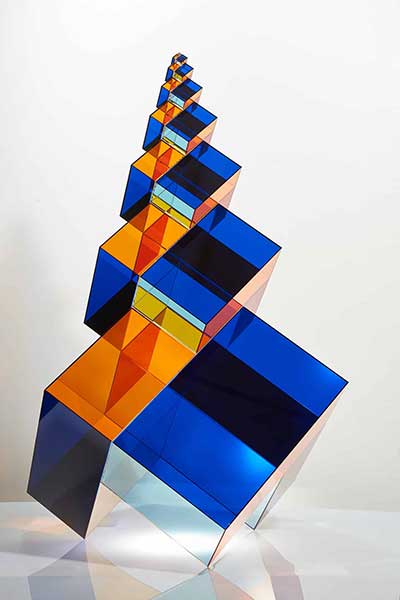
Hürsch‘s ambition is to make the inherent beauty of mathematical concepts visible, without requiring audiences to appreciate or understand the concepts themselves. Even so, he is particularly gratified when aesthetically oriented audiences get curious about the math that makes his art function.
Hürsch has displayed his work across Northern Europe and Canada, including twice at the Bridges conference, an international meeting on the intersection of art and mathematics. He enjoys sharing his art with an audience that, like him, finds the natural harmony of mathematical art to be intuitively appealing.
Hürsch is grateful for his time at Northeastern, and in the tech world more generally, for teaching him his considered, methodical, and organized approach to complex tasks. It’s served him well, as he’s found himself applying the skill set across both his careers.
“I observed in many startups that when you scratch the surface and start getting interested in an area, it opens a universe of its own. You go in, and then it gets bigger and bigger, and your head explodes because it’s so broad, but it gives you a lot back because you’re in another world,” Hürsch said. “The same is true with art; there are things like the techniques, how fragile are the colors, do they come off with time or not? It’s like a Fibonacci number. Everything gets bigger.”
On the aesthetic side, Hürsch is looking forward to expanding his portfolio of sculptures; on the business side, he’s excited to secure permanent gallery representation. He’s found that his background in tech startups has been particularly helpful in building the business side of his art career, as branding, marketing, and building relationships with suppliers have come easily to him.
Hürsch advised younger students interested in both art and tech to tackle their passions one at a time, rather than trying to become everything all at once. Approaching art this way meant that his time in tech could inform his second career, rather than competing for his attention.
“I was always interested in art, but I focused my creativity on the tech side for a long time. If you want to become successful, you need to focus on one work,” Hürsch said. “But if you’re open minded, then you can draw from what you learn in one professional world and take that on to another one. That really helps me now, to have all that mindset behind me; it gives me lots of energy.”
Visit Hürsch’s website to explore more of his work.
The Khoury Network: Be in the know
Subscribe now to our monthly newsletter for the latest stories and achievements of our students and faculty