Khoury News
Northeastern student-led hackathon sparks health care innovations, internship offers
A AI-powered trigger detector, a personalizable learning tool, and an injury recovery platform took home honors at Hack Health, a student-led hackathon in which sponsoring startups influenced competitors' projects.
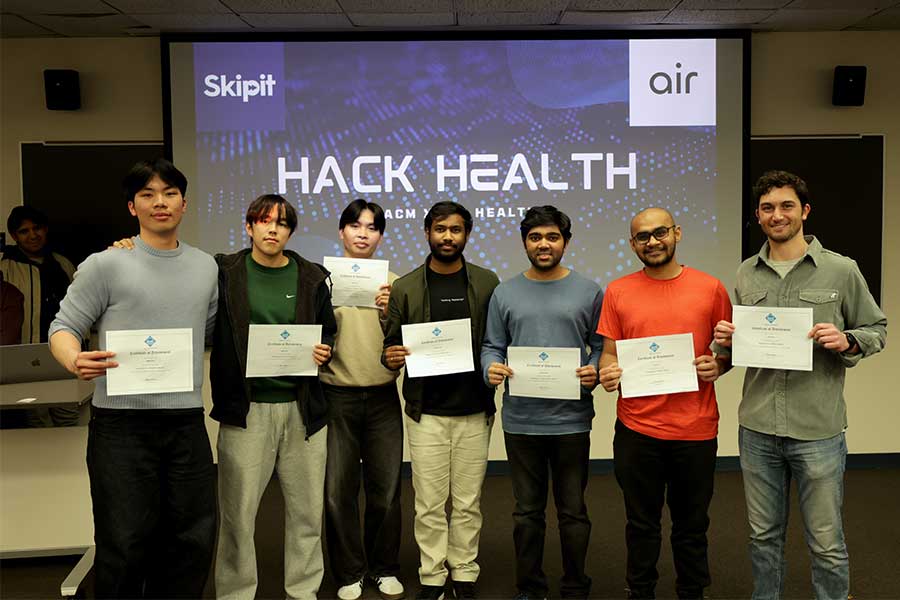
Hack Health, a student-led hackathon held in mid-March at Northeastern University, brought together aspiring developers, entrepreneurs, and students interested in health care innovation. Unlike a traditional hackathon, the event connected real-world needs with technical talent by partnering participants with startups and founders.
The event reflected two broader goals. The first was to turn hackathons into more than just short-term competitions by emphasizing collaboration, impact, and direct pathways into industry, as winning teams were offered internships with the startups they collaborated with.
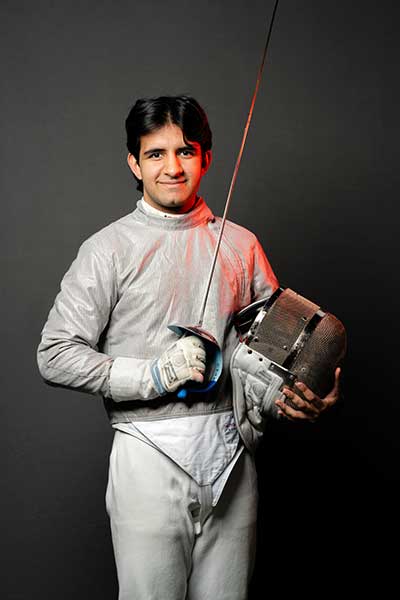
The other was to revitalize Northeastern’s chapter of the Association for Computing Machinery (ACM). Ekam Bhatia, a second-year data science and math combined major who chaired the club in 2025–26, led the executive board of 10 in an effort to provide opportunities for Boston-area students. Bhatia aimed to transform the club into a more engaging and career-oriented community by building a strong software team and fostering connections with startups. He noticed that early-stage founders often lack technical collaborators, while students often struggle to find relevant internships.
“I really wanted to create a bridge to combine that passion where not only would you have technical founders or startups, but also technical students who are looking to create products that actually make a difference,” Bhatia said. “I thought about creating a new kind of hackathon, especially since Boston is really strong in health tech.”
The hackathon had three tracks: physical health, mental health, and educational health. The roughly 60 student attendees divided themselves into small teams, with each focused on different areas within those themes.
Mental health track
Kunj Joshi and Justin Feldman, both master’s students studying computer science, were tasked with building a solution alongside a sponsoring startup, SkipIt. After hearing pitches from the partner startups, Joshi and Feldman were drawn to SkipIt’s mission of helping users avoid triggering content in movies and TV shows. They designed a project that could expand the startup’s existing product and make it more flexible for a wider range of users.
Their project, called Trigger Detect, extended SkipIt’s core idea by introducing customizable triggers, rather than limiting detection to predefined clinical categories. Inspired by personal experiences, such as Joshi’s allergy to bee stings and Justin’s arachnophobia, the team built an AI system that allows users to input specific fears or sensitivities in natural language. The system then converts those inputs into actionable tags using a large language model and applies computer vision techniques to scan video content for those elements. If a trigger is detected in an upcoming scene, the system alerts the user and gives them the option to skip it, making media consumption more accessible and personalized.
As Feldman explained, “Not everything falls into bins of traumas … it’s hard to be so granular when it comes to what a trigger could be for any given user.”
“It might be bees for me,” Joshi added. “It might be guns for someone else. It might be spiders for someone else … It was really a software development problem, a real algorithm problem in computer science.”
Trigger Detect required more than just plugging in AI models. Joshi and Feldman had to design efficient pipelines to process video frames ahead of playback and ensure the system could identify objects accurately in real time. Their approach combined machine learning, computer vision, and core computer science principles, highlighting the importance of strong technical foundations even in AI-driven projects.
Ultimately, their solution stood out for its practicality and innovation, earning them a win in their track and opening the door to an internship opportunity with the sponsoring startup.
Education health track
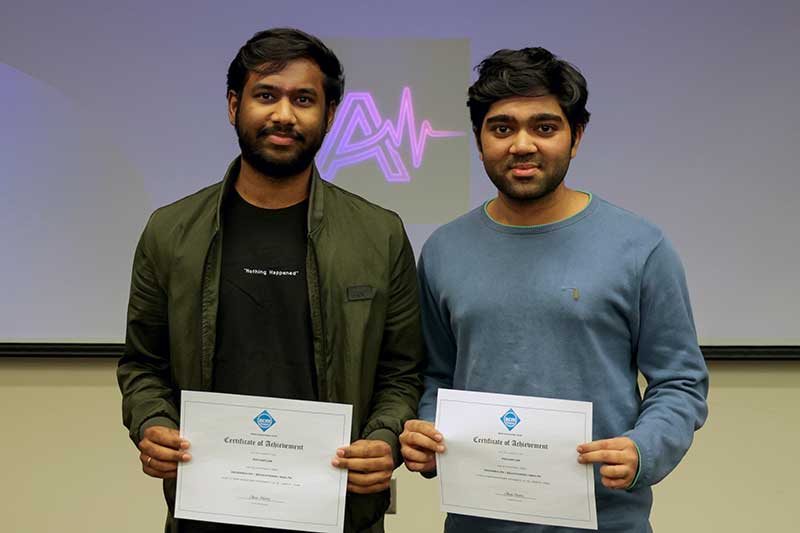
Om Patel, a master’s student in applied artificial intelligence, partnered with Vamsi Yanamadala, a master’s student in cybersecurity, to develop a category-winning solution focused on improving learning experiences for students. They approached the competition with an interest in combining their technical backgrounds to address challenges in education, particularly for students who struggle with traditional study methods.
Their project, called Focus Flow, is an AI-powered adaptive study session manager designed for neurodiverse students. The tool aims to personalize study sessions by adjusting to a user’s focus levels, learning patterns, and individual needs. Rather than offering a one-size-fits-all approach, Focus Flow uses intelligent systems to help structure study time in a way that maximizes productivity, reduces cognitive overload, and support students who benefit from customized pacing and guidance.
“We wanted something that doesn’t assume every student learns the same way, because that’s just not reality,” Patel said.
The team’s work highlights how AI can be applied beyond traditional productivity tools to create more inclusive educational technologies. Focusing on neurodiversity, Om and Vamsi addressed a gap in many existing study platforms, which often overlook the varying ways students process information and maintain attention.
“The hardest part wasn’t building the model — it was making it respond in real time to how a student’s attention actually shifts during a session,” Yanamadala said.
Physical health track
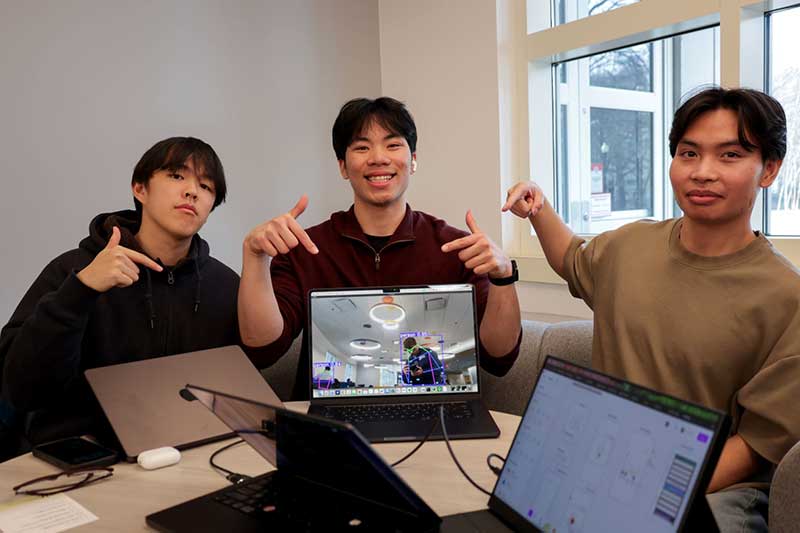
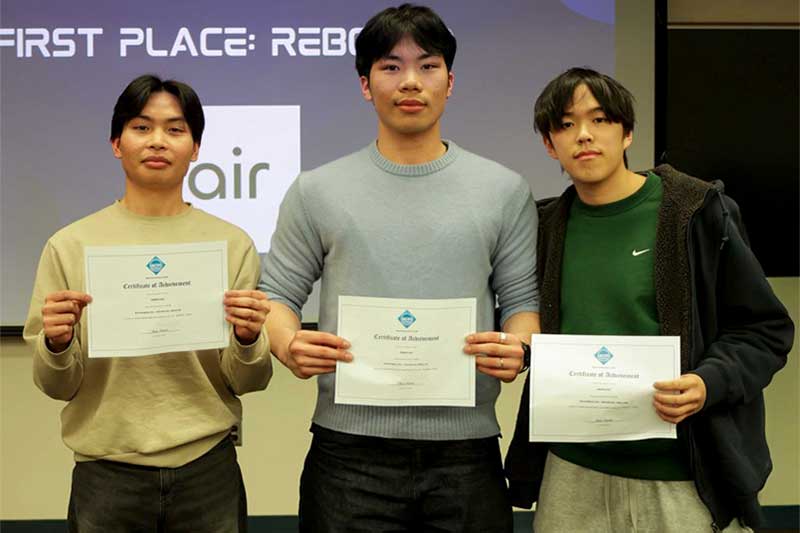
The winning group in the physical health track group, which teamed up to build an injury recovery and rehabilitation platform, consisted of Phillips Le, a second-year biomedical engineering student at Boston University; Michael Zhang, a second-year computer science student at Northeastern University; and Nghia Trang, a second-year computer engineering student at Boston University.
The group formed shortly before the hackathon began, bonding over a shared interest in health care and technology despite not knowing each other beforehand. Their mix of technical backgrounds helped them approach the problem from multiple angles, combining software development with an understanding of patient needs.
Zhang said the team’s project, Rebound, was designed as a practical recovery tool for users managing injuries, with the goal of making the app accessible to as many people as possible.
“It’s an app that helps injured people, no matter if you’re an athlete or just a normal person … rehabilitate their injuries, serving as an assistant and the connection to doctors and injury rehabilitation services,” Zhang said.
Rebound evolved into a personalized recovery platform that allows users to track pain, complete rehabilitation tasks, and monitor their range of motion using computer vision. It also includes maps to help users find nearby care providers, as well as insurance coverage information to help users access treatment more efficiently.
The team balanced front-end and back-end development under tight time constraints, building systems for health data tracking and computer-vision-based motion analysis, as well as an interface designed to simplify complex medical information. Their work earned them a win in their track and an internship opportunity with AIR Health, a respiratory care startup.
The Khoury Network: Be in the know
Subscribe now to our monthly newsletter for the latest stories and achievements of our students and faculty