Khoury News
Real clients, real data, real impact: Khoury master’s students tackle Maine community needs
By partnering with local news, hospital, and charitable organizations as part of their coursework, master's students at the Roux Institute have put their data skills to use in the community.
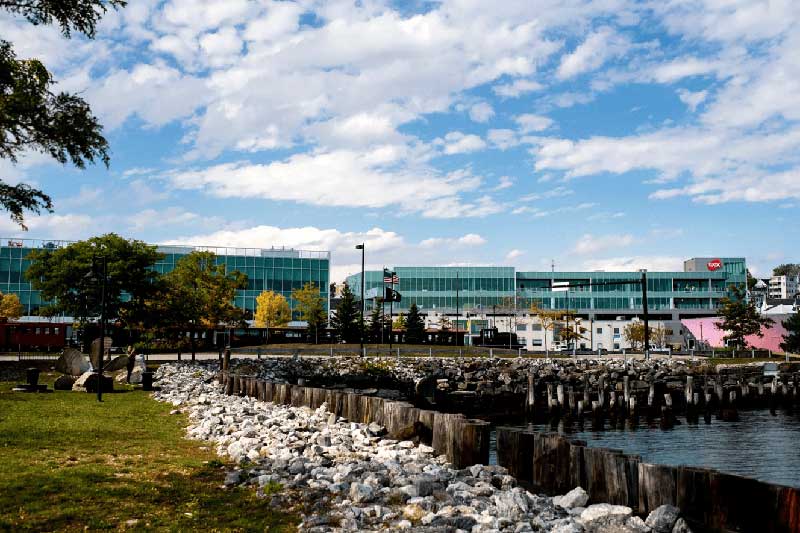
One of the most important challenges for educators is preparing students for the real world. Northeastern’s Roux Institute in Portland, Maine tackles this problem daily by integrating real-world experience into coursework through its Experiential Network (XN).
The program pairs students with local organizations to design class projects around specific organizational needs. Throughout the process, employees answer questions, attend the students’ final presentations to offer feedback, and, in some cases, invite students to present their work to the rest of the organization.
These projects foster connections between Northeastern students and local organizations that endure beyond the classroom, often leading to co-ops, internships, or paid research, and giving students a taste of life in the workforce.
According to Experiential Pathways Program Manager Dave Munger, the Roux Institute has already collaborated with more than 90 different partners to complete over 140 projects across all academic programs. Khoury courses alone have accounted for at least 70 of these projects.
Assistant Teaching Professor Ryan Bockmon of the Roux Institute has overseen many of these projects, ranging from identifying people at risk of falling into poverty to finding areas underserved by local news outlets.
Muhammad Baig: Using data analysis to identify at-risk populations
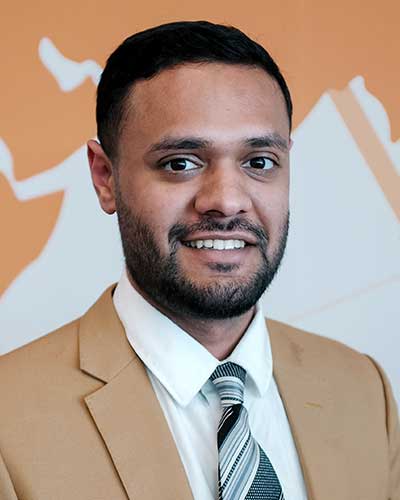
As part of his “Foundations of Artificial Intelligence” course, first-year AI master’s student Muhammad Baig was tasked with analyzing municipal grant funding for the Southern Maine branch of United Way (UWSM), a global nonprofit dedicated to addressing root causes of issues like food insecurity, housing instability, literacy gaps, and access to health care.
“Organizations in the Portland area apply for municipal grants, and we analyzed which organizations are getting the most funding relative to what they’re requesting. In other words, how successful they are in acquiring funds,” Baig says.
For his final project, Baig helped UWSM analyze the surveys it conducts to determine which Portlanders are most at risk of falling below the poverty line. This project was part of United for ALICE, a program within United Way dedicated to identifying and assisting people who are employed but still struggling to stay afloat.
Baig and his classmates integrated results from three surveys to help stakeholders at UWSM identify trends among the most vulnerable survey-takers.
“I think the question that we utilized the most heavily was ‘If you had to pay $400 for an emergency right now, could you pay out of pocket?’” Baig says. “That’s sort of their identifier for someone who is at-risk.”
Baig says the third survey is more involved than a simple question and answer form. UWSM volunteers visit the people identified as at-risk and talk to them to identify how United Way can assist them most effectively.
Baig’s final presentation was attended by a chief data engineer at UWSM as well as several other employees, all of whom were impressed with the results.
“We found quite a few counterintuitive things,” he explains. “You’d think that poor people would struggle with affordable childcare a lot more than richer people or people above the poverty line. But actually, we found that people close to poverty don’t even consider that they could pay someone to look after their child. They don’t even list it as a concern. There were a lot of quirky little findings like that.”
Coming into a master’s program straight from an undergraduate program, Baig lacked industry experience, so experiential learning has proven invaluable at bridging the gap between school and the working world.
“You get to be a lot more creative than on a homework assignment,” Baig says. “You don’t have a specific regimen. No one’s going to tell you have to do something. You have to figure it out on your own, and I feel like that’s a pretty important skill.”
Lifei Wang: Analyzing survey data to understand violence in hospitals
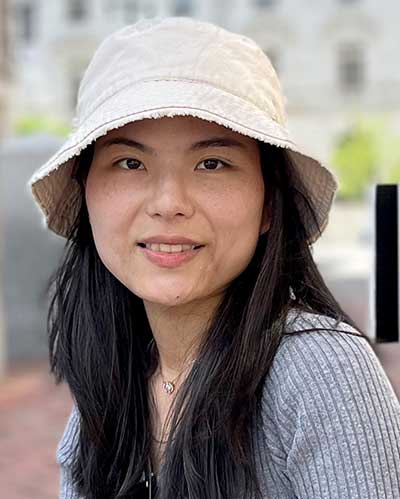
For her final project in “Intro to Data Management,” third-year computer science master’s student Lifei Wang analyzed data for the Maine Hospital Association (MHA), a nonprofit advocacy group which represents community-governed hospitals and advocates for the well-being of nurses and doctors.
“MHA sent a survey to hospitals in Portland and asked them questions about the level of violence in hospitals,” Wang explains, “because sometimes the patients, when they have issues with insurance or they’re waiting too long for a bed, can be triggered and insult or even hit the nurses and doctors.”
Over the course of the project, Wang learned that an important part of presenting project results is knowing your audience, something that’s especially true for an organization involved in politics.
“MHA prepares and presents findings to the local government because they want to push them to make laws to protect health care workers,” Wang says.
Wang is an Align student with a background in business. That experience, combined with her classmate Yueheng Yuan’s experience with AI analytics, made them a formidable duo, earning them the opportunity to conduct paid research for MHA after the semester ended. The funding and added time allowed Wang and Yuan to explore the same survey data to new depths.
Most helpful of all, Wang found the experience instructive in shaping her future career path.
“At the end of this project, I understood that I don’t want to compete with AI; I want to do what AI cannot do,” Wang says. “For example, AI needs to work with clean data, so data cleaning is something a human needs to do.”
Brandon Villalta Lopez: Tracking local news subscribers around the world
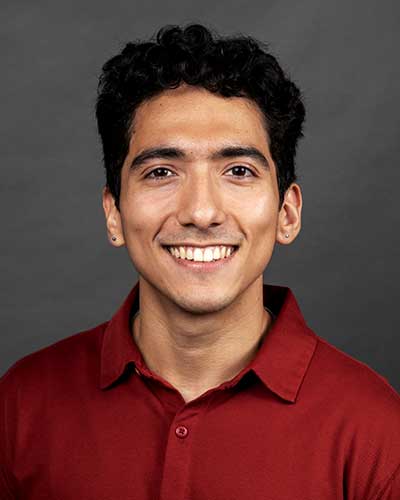
For second-year data science master’s student Brandon Villalta Lopez, experiential learning was part of his “Essentials of Data Science” course. He worked with Maine Trust for Local News (MTLN), a nonprofit network of independent news outlets.
Villalta Lopez and his team were presented with a dataset full of information about subscribers to MTLN’s news outlets.
“They wanted to see what areas in Maine were underserved so that they could put resources into those areas in the form of more on-site journalists and targeted advertising,” Villalta Lopez says.
The subscriber data was mostly geographic, lacking personally identifiable or demographic information. While not as useful as a typical dataset used for market research, it was enough to yield unexpected insights.
“There were little interesting things like the fact that there are MTLN subscribers all around the world,” Villalta Lopez explains. “Every state had subscribers to local Maine newspapers, and almost every military base in the world had them. Massachusetts was the second most popular state, which makes sense. But then Florida and California were the next most popular … We assumed maybe those are people who summer in Maine and winter somewhere else.”
This was not Villalta Lopez’s only experience with experiential learning or MTLN. He worked with them again on a project for his “Unsupervised Machine Learning and Data Mining” course.
“This one was about classifying news articles into different types of user needs,” Villalta Lopez says.
While representatives from MTLN attended their presentation in the first class, this time, Villalta Lopez and his teammate went to them.
“They gave us a tour of Maine Trust for Local News and showed us where they print the newspapers. And then we got to sit in a meeting room with the people who would act on our findings, present our work, and answer questions. It was really awesome to interact with the stakeholders that closely,” Villalta Lopez says.
Villalta Lopez’s experience with MTLN ultimately netted him a summer co-op with the organization. After that, he hopes to stay in academia, but this connection with a local nonprofit expanded his network and opened him to new career possibilities.
“I think my main path right now would be to go into a PhD, but I am considering that there may be a path where I finish this master’s and stay working in Maine for a while before jumping into a PhD,” Villalta Lopez says. “It might be a richer experience perhaps, so I’m keeping my options open at the moment and waiting to see what happens.”
The Khoury Network: Be in the know
Subscribe now to our monthly newsletter for the latest stories and achievements of our students and faculty