Khoury News
Research that hits home: Erika Melder’s community-based push for user-friendly social media
Social media platforms often want to be as big as possible, and in as many ways as possible. But one Khoury PhD student is finding that many communities want just the opposite, both for camaraderie and protection.
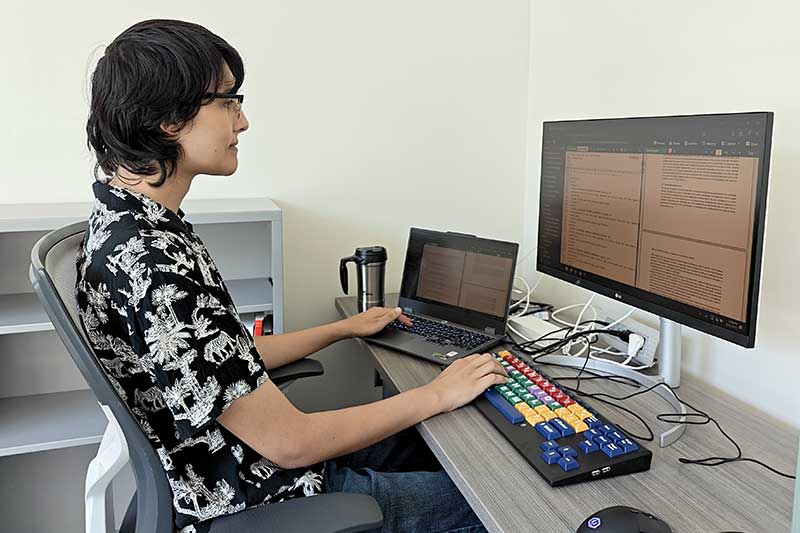
This story is part two of a six-part Khoury News series called “Research that hits home,” which showcases researchers who come from — or form close partnerships with — the communities they study. The first installment covered the principles of epistemic justice and Michael Ann DeVito’s research into queer online communities.
Social media has drifted a long way from the connected community promised by websites like MySpace and Facebook in the early 2000s. For many, being online has become often unenjoyable or sometimes unsafe, and nowhere has this been truer than in the communities of trans women that doctoral student Erika Melder studies.
Which is why their optimism is a refreshing surprise.
“I’m excited to have a vision of social media where people can feel safe and welcome to participate, where I don’t have to fight against algorithms pushing me to engage in a way that I don’t want to, where it feels like the social media we were promised,” Melder said. “Quitting social media is one answer, but I think we can keep social media. It just has to change.”
Melder uses epistemically just methods — which respect a community’s knowledge about itself — to study community governance and boundaries in online transfeminine communities. In doing so, they have identified technical options that could reconceptualize online spaces around users’ needs and desires, creating a more human-friendly internet.
When they wanted to learn about building a livable internet, Melder turned to the transfem community — partly because they were already part of it, but also because marginalized people often suffer through more extreme versions of ubiquitous problems.
“When transfem people are on social media, there’s a risk of harassment, transphobia, all kinds of pushback. It’s framed in broader social media spaces as a debate, and when folks go online, they’re trying to fight a battle against an opposing side,” Melder explained. “In smaller spaces, we can create a space where users don’t have to fight just to exist. These spaces are often refuges for marginalized people.”
Those communities frequently form on social media platforms like Mastodon, Bluesky, and Discord that allow for smaller subcommunities, are often fiercely protective, and frequently share mutual aid resources among themselves. However, most social media platforms are built to value virality and lack tools to insulate a growing community. As a result, these communities often fend off harassers using ad hoc measures like block lists — massive spreadsheets that list users for community members to ignore.
But these measures also make it easy for interpersonal schisms to spiral. Melder gave the example of two large queer communities on the decentralized social media website Mastodon, which had blocklisted one another because two administrators disagreed about how to handle a moderation case.
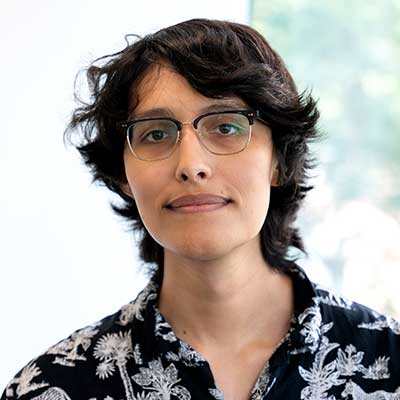
“When we talked to people who ran these block lists, a lot of them viewed it as mutual aid; they said, ‘This is me protecting my community.’ But the people who were blocked didn’t see it as mutual aid at all,” Melder said, noting that Mastodon’s mechanics ensured lots of people saw every post, pushing the two communities together and turning differing priorities into a source of conflict. “People were using systems like blocklists to fight against Mastodon itself. Mastodon promotes reach, but that’s not what people wanted. They wanted their [community] to be local.”
In addition to interviews, Melder gathered stories like these using an Asynchronous Remote Community (ARC) study, a semi-structured online community in which researchers can post questions, provide prompts, and lightly mediate discussions.
“It allows people to do more creative exercises. We had a lot of visual elicitation, drawing, and collage-making. We had folks submit a meme, give advice to a fictional person, draw their social media space as a house party,” Melder said, describing how these nontraditional questions let them gather both explicit opinions about social media and more subtle insights into participants’ worldviews that are incredibly useful for designing a digital world. “Through those creative insights, we got very rich and useful data that helped so much more than any text interview or focus group.”
To Melder, the most interesting insight was how much people thought about social media as — and wanted to interact with it like — a physical space.
“Going on Twitter is like going to a party where everybody has a microphone hooked up to the house’s stereo system; if somebody’s talking, everybody hears it,” Melder said. “But what if Twitter had channels, like rooms within a house party? What if there was a sense of locality where they could converse with each other? What if there were hallways between channels where you could have little conversations?”
Melder also identified two technical changes that could allow users to more comfortably inhabit their digital communities. The first was to return control over a post’s reach to the user, with options like local-only posting and a broader range of privacy settings. They found users often spoke more freely when they controlled who they’re speaking to.
The second was to codify ad hoc security practices like community block lists into platforms. Building community boundary controls into the platform facilitates consistent governance, so blocked users could appeal decisions and blocklist creators could respond to new information.
The initial feedback has been positive.
“A lot of folks are mistrustful of ‘big tech’ in blanket terms, so giving users tools to protect yourself is the natural progression; it’s something that they wanted to see for a while,” Melder said.
They also believe there’s a lot in their study — which was published in CSCW earlier this year — that could benefit internet communities more broadly, including the use of ARC-style forums to hash out community rules and local-only posting to give users more control over their posts. In the meantime, Melder is excited to continue using ARC to study communities they care for and says being a member-researcher helps them have the empathy, context, and trust to conduct insightful research.
“Epistemic autonomy, to me, is making sure that all people … can experience and express knowledge,” Melder said. “I’m going to take their experiences and say, ‘This is the lived truth of my participants; how can I look at the structures we’re building to make that lived experience better?’”
The Khoury Network: Be in the know
Subscribe now to our monthly newsletter for the latest stories and achievements of our students and faculty