Khoury News
Undergraduate researcher honored for research on female computing participation
When McKenna Quam arrived at Northeastern, she wasn't planning to be a researcher. But the chance to study female participation in CS was just too tempting, and a recent CRA honor shows how far she's come.

McKenna Quam, a fourth-year data science major, did not come to Northeastern thinking of herself as a researcher. However, after publishing several papers and receiving an honorable mention from the Computing Research Association (CRA) to recognize her “outstanding research potential,” Quam has started to see herself in a different light.
“Now I’m like, ‘Oh, yeah, two published papers, you have to call yourself a researcher, McKenna,’” she said.
Quam’s journey with research began in her first-year “Foundations of Data Science” course.
“Dr. Albert Lionelle asked if anyone was interested in research, and to be honest, I wasn’t sure if I would be the right fit for helping out, but I liked Dr. Lionelle, and the research project was about women’s participation in computer science,” Quam said. “That’s a subject I hold very dear to my heart.”
Quam’s first project focused on curricular complexity, which required mapping degree requirements and structures onto a graph. This allowed researchers to analyze which courses acted as blockers for other classes and determine the overall complexity of a degree.
To compile the data, Quam explained, “You have to go in and find the degree website and then find every single course, put that into the machine, and the machine will give you back a number. Then you have to map the whole thing.”
This process was extremely time intensive. While working on this paper at Northeastern’s Center for Inclusive Computing (CIC), Quam began to wonder if she could extend her research into a co-op position.
“I was doing the work on a volunteer basis for a very long time, and eventually, I asked, is the CIC hiring?” Quam recalled. “I finished the first paper while doing a co-op there.”
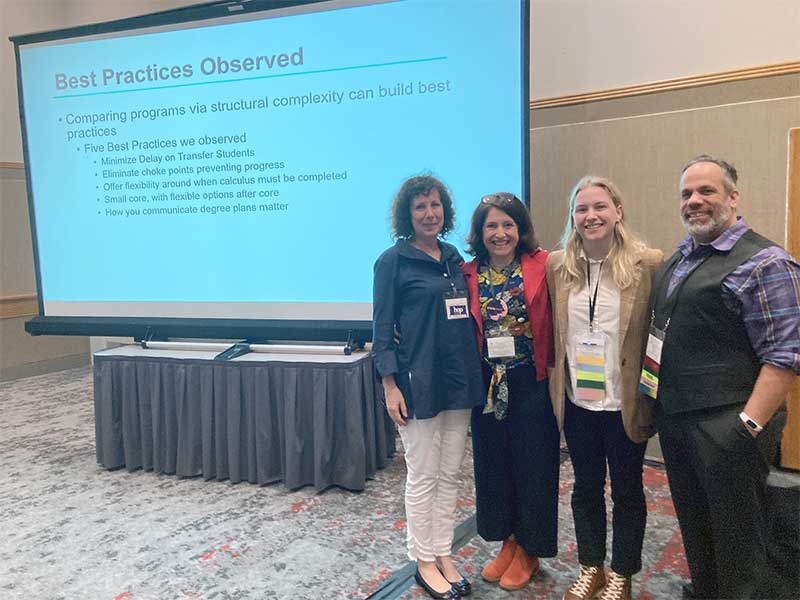
Albert Lionelle
The paper revealed that higher-complexity degrees had lower levels of female participation, while simpler degree structures saw greater female enrollment. These findings led Quam to explore the reasons behind these disparities.
“If you’re not encouraged to pursue something in high school, you have to find it in college,” she explained. “The longer you make your degree take, the longer those paths are, or the more involved the prerequisites are, the less likely you are to try it.”
For Quam, the study highlighted how differences in early encouragement could impact participation in computer science. The CIC, she explained, is working to identify and address these disparities.
“The CIC has 10 interventions to get more women and more marginalized identities to participate in computer science,” she said. “When I talk about this work, a lot of people are like, ‘Well, wouldn’t a lower-complexity degree benefit everyone?’ And yes, it would. Removing barriers to CS helps everyone, it just so happens that there are more barriers for women in CS education.”
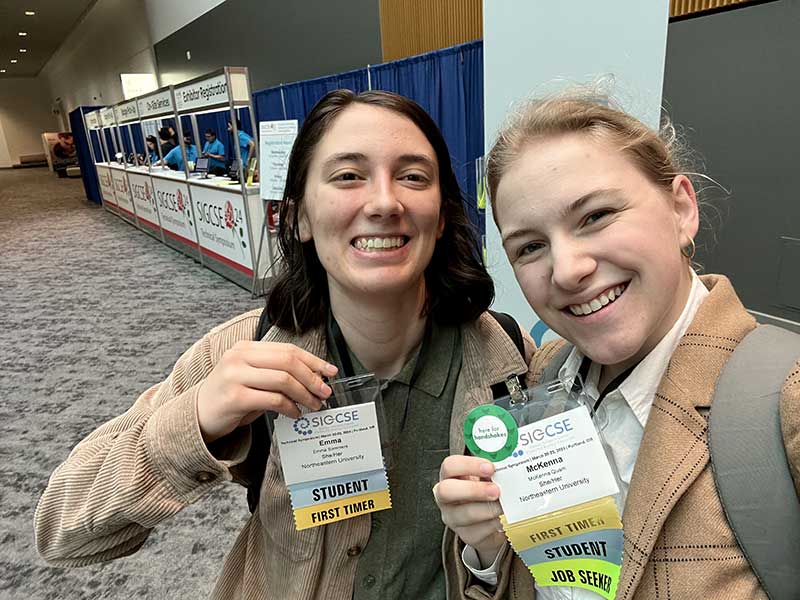
Quam’s first paper was published at SIGCSE TS, the flagship conference of the Special Interest Group on Computer Science Education, where she presented her findings in March 2024. This conference, she said, felt especially impactful because “people in this room are computer science administrators. They are computer science teachers. They’re the ones creating these undergraduate curriculums. If they can listen to me, if anything sticks from my presentation, that might mean that somebody, somewhere, gets involved in computer science who wouldn’t have previously.”
While working on that paper, Quam noticed that different degrees had different math requirements. For example, one degree at one school might require calculus before fundamentals of computer science, and another school may not require calculus. This led to Quam’s second research paper, in which she and her coauthors “surveyed 199 undergraduate CS degrees, which covered around 60% of all undergraduates in the United States who earned a CS degree in 2021.”
Through this research, they uncovered significant inconsistencies.
“There are some degrees where Calculus 1 blocks zero classes, and there are some degrees where Calculus 1 blocks 30. It is an absolute disparity,” Quam explained.
These findings indicated that differing math prerequisites could present barriers for students.
“When calculus blocks 30 classes, it’s because you have to take calculus before you take your first CS class, and calculus is a concept that is important to understand,” Quam noted. “Consider a student who didn’t take high-level math. If you’re just discovering computer science in college or high-level math in college, it’s another barrier to participation.”
Throughout both projects, Quam also wrote an academic op-ed, known as a white paper, outlining 10 ways universities can make degree requirements more transparent.
“I have looked at so, so many of these sites, and so I thought I should use this knowledge to tell other people about what I figured works well for communicating requirements and what doesn’t,” she said.
The white paper included recommendations such as “Hyperlink Everything – Avoid Dead Ends” and “Words Please – Course Codes Mean Nothing to Me.”
Although each of her research projects tackled different aspects of degree accessibility, Quam sees them as deeply connected.
“All of these things, when you end up making a body of work like I did, flow into one another,” she said. “You start with a question that you want to research, and then that question makes you think about other questions.”
The accessibility theme of Quam’s research stems from her own experiences.
“I’m so lucky to have people in my life who inspired me to see myself as a mathematician and as a computer scientist, but so many other people don’t have that,” Quam said. “For people who design these curriculums, they need to think of the student who comes to your university and hasn’t taken pre-calc. Does your university allow them the space to become a computer scientist?”
As for her next steps, Quam has accepted an offer from EPFR, where she completed her second co-op, to serve as a quantitative analyst full-time after graduating. In this new role, and in general, Quam said she “will continue to advocate for women, both intentionally, but also just by being a woman in male-dominated spaces.”
The Khoury Network: Be in the know
Subscribe now to our monthly newsletter for the latest stories and achievements of our students and faculty